Salt water, constant vibration and a machine space that never really cools down — a ship is a brutal test rig for cable protection. Add the classification requirements of class societies, and marine cable insulation becomes a documentation exercise as much as a materials one. Chengrun supplies sleeving, tubing and tape that survive the marine environment, with the paperwork that lets a yard prove it.
The marine failure modes
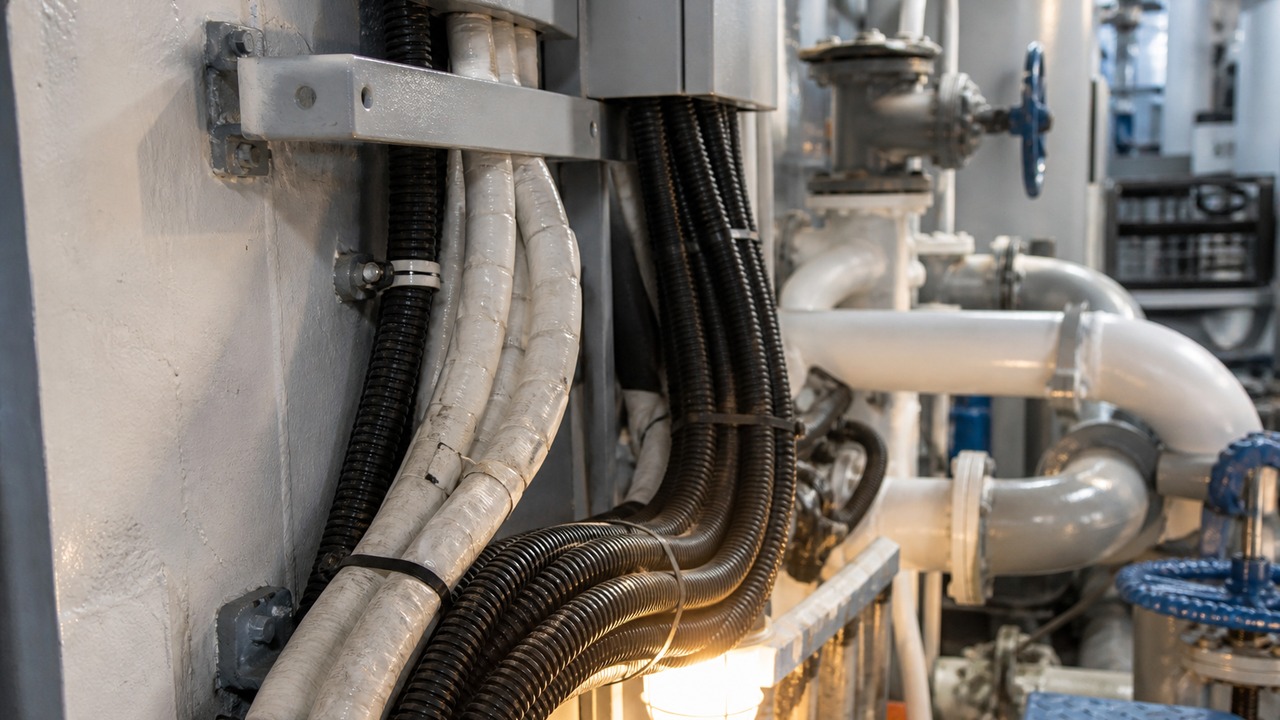
Three problems dominate shipboard electrical maintenance. Corrosion: salt-laden air attacks metals and degrades some plastics from the surface inward. Vibration: engines and pumps fatigue a cable until the jacket cracks at a clamp. And fire: an engine-room cable must not propagate flame into a passage, so every material has to be low-smoke and self-extinguishing.
Engine room, up to 200°C
Near a main engine or an exhaust run, standard PVC sleeving hardens and cracks within months. Silicone coated fiberglass sleeving keeps its flexibility at continuous 200°C and resists the oil mist that coats every surface in a machine space. Where a cable passes a hot pipe, silicone fiberglass fire-proof tube adds a fire barrier, and extruded silicone fire resistant tube gives a smooth, wipe-clean surface for exposed runs.
Deck, bilge and cable runs
On deck, cable meets UV, spray and mechanical abuse. Corrugated tube in PA or PP provides a flexible conduit that resists impact and chemical splash while keeping water out of the bundle, and nylon conduit tubing handles tight routing around bulkheads and frames. In bilges and tanks, tinned-copper options add corrosion resistance where a copper screen would otherwise corrode.
Bundling, chafe and EMI
In a dense cable tray, chafe between cables causes more faults than any single stress. Expandable braided sleeving bundles a run and holds it against vibration, while PET tinned copper braided sleeving adds EMI screening for navigation, radio and control cables that must stay clean. Where a screen has to stay flexible at a hinge or a door, tinned copper self-closing wrap installs over an existing cable without disconnecting it — a real advantage on a retrofit.
Terminations, glands and repairs
Marine repairs happen at sea, with limited tooling. Heat shrink that closes over a joint is often the fastest way to restore protection. Adhesive lined dual wall heat shrinkable tubing seals a splice against moisture, and DR diesel resistant heat shrinkable tubing resists fuel and lube oil in the areas where spills are routine. For chemical and hot-water lines, PTFE heat shrinkable teflon tubing offers near-universal chemical resistance and one of the widest temperature windows available.
Tape for the last metre
Marine electrical work still ends with tape. Acetate cloth tape gives a hand-tearable, high-temperature wrap for harness finishing. PVC tape covers general bundling under a gland. And PET cloth tape handles the jobs that need extra tensile strength, such as securing cable on a tray.
Specification guide
Location |
Material |
Engine room, 200°C |
Silicone coated fibreglass sleeving |
Exposed hot pipe crossing |
Silicone fibreglass fire-proof tube |
Deck conduit |
PA/PP corrugated tube |
Cable tray bundle |
Expandable braided sleeving |
Signal / navigation screening |
PET tinned copper braided sleeving |
Sealed splices |
Adhesive-lined dual-wall heat shrink |
Fuel-oil area |
DR diesel-resistant heat shrinkable tubing |
Chemical / hot water |
PTFE heat shrinkable tubing |
Compliance for the yard and the class surveyor
Documentation decides whether marine materials get approved. Chengrun supplies UL and CSA listings, RoHS 2.0 and REACH SVHC declarations and Prop 65 statements per model, alongside material datasheets your classification submission can cite. The Dongguan factory operates under an ISO 9001 and IATF 16949 quality management system.
One supplier for a shipyard's whole cable list
Class documentation and traceability
A classification submission needs evidence, not a datasheet alone. For marine work, expect to provide material temperature class, flammability and smoke data, halogen content, and a declaration of conformity for each item on the cable list. Chengrun issues per-model documentation — UL and CSA listings, RoHS 2.0 and REACH SVHC declarations and Prop 65 statements where they apply — and lot traceability runs from incoming fibre to finished roll, so a surveyor can follow a batch back to its raw material.
Repair and retrofit at sea
Marine maintenance rarely happens in a workshop. A cable has to be re-protected in a machine space, at a bulkhead or behind a panel, often without disconnecting it. That is why self-closing wraps and heat-shrink joints matter more on a ship than on a production line: both install over an in-service cable. It is also why cut lengths and pre-formed parts are worth specifying in advance — a stocked set of the two or three sizes a vessel uses most turns a two-hour repair into a fifteen-minute one.
Yards and offshore builders buy insulation across dozens of cable types and often wait on the slowest vendor. Chengrun makes the full range — fibre braiding, silicone coating, extrusion, tape converting and die-cutting — under one roof, so you place one order, get one packing list and hold one spec standard. Send your drawing, ambient and continuous temperature and the class requirement, and an engineer will respond within 24 hours.
 EN