EN
Global automotive wiring harness sales reached roughly USD 90 billion in 2025, and analysts expect the market to keep climbing toward USD 126 billion by 2035 (Precedence Research). Most of that growth is electric. Higher voltage platforms, more sensors, more cables per vehicle.
A car is a wiring problem on wheels. A modern vehicle carries 1,500 to 2,000 meters of cable, routed through engine bays that reach 150°C, underbodies that take road splash and stone impact, and doors that flex a million times. Every one of those meters needs insulation that holds up.
Chengrun has built insulation materials since 2001. The factory runs 1,000+ machines across two sites (30,000 m²), with 8 dedicated high-temperature lines, under a TS16949 automotive quality system. The sleeving, conduit, heat shrink, mesh and tapes protect harnesses for OEM supply chains including BYD, Geely and Changan. This page covers where insulation fails in a vehicle, and what to specify.
Short version: in a car, insulation fails long before the wire does.
Failure mode |
What happens unprotected |
Where it hits |
Engine bay heat |
Insulation melts, wires short |
Exhaust side, turbo, manifold zones above 150°C |
Vibration and abrasion |
Chafing exposes copper |
Engine mounts, chassis edges, door hinges |
Oil, fuel and coolant |
Tubing softens and cracks |
Underhood fluid exposure |
High voltage (EV) |
Arc flash, dielectric breakdown |
400V and 800V platforms |
Moisture and road splash |
Corrosion, gradual failure |
Underbody, wheel wells, connectors |
Compliance |
OEM audits fail |
IATF/TS16949, UL, ROHS, REACH requirements |
The wire itself rarely fails first. The sleeving around it does. That is why OEMs and Tier 1 suppliers treat insulation as a specified part, not an accessory.
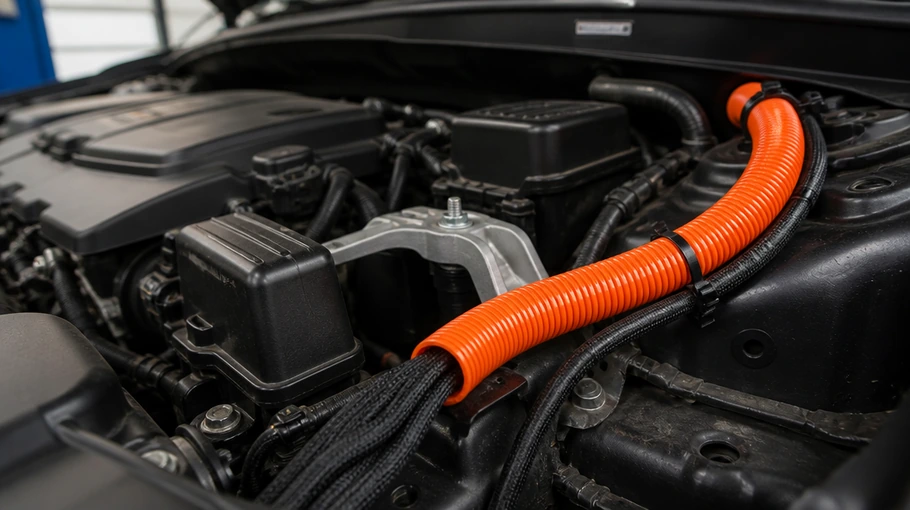
The hottest real estate in the car. Exhaust manifolds, turbos and catalytic converters radiate heat that ordinary PVC tubing cannot survive. Silicone fiberglass sleeving (SFT series) and silicone rubber fiberglass sleeving handle these zones, rated for sustained high temperature and flexible enough to follow tight routing.
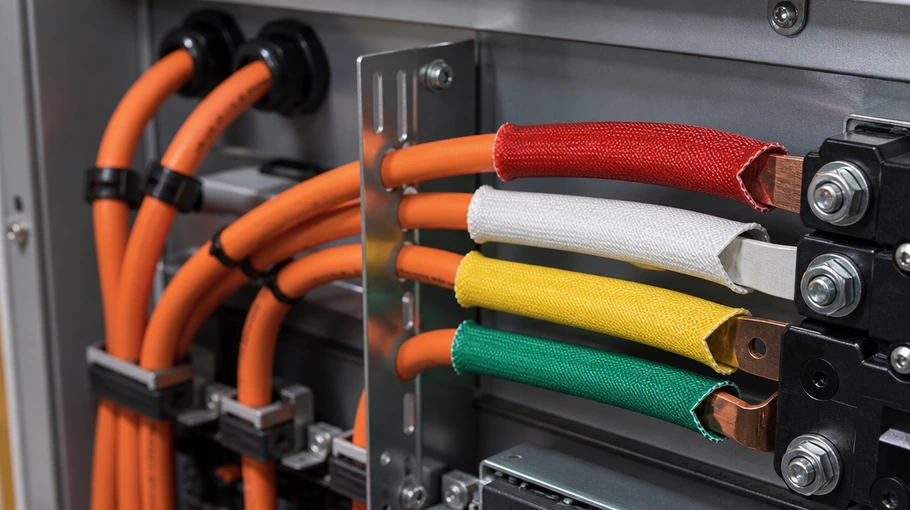
Electric platforms run 400V today and 800V tomorrow. The orange cables between battery, inverter and motor carry full pack voltage through the vehicle. Fiberglass fireproof sleeving adds dielectric strength and flame resistance; PTFE heat shrink tubing seals the connector ends. Spec the sleeving as carefully as the cable itself.
Underneath the car is a sandblaster with water. PA/PP corrugated conduit takes stone impact and abrasion, and keeps looms organized. Braided mesh adds a second layer where cables cross sharp edges.
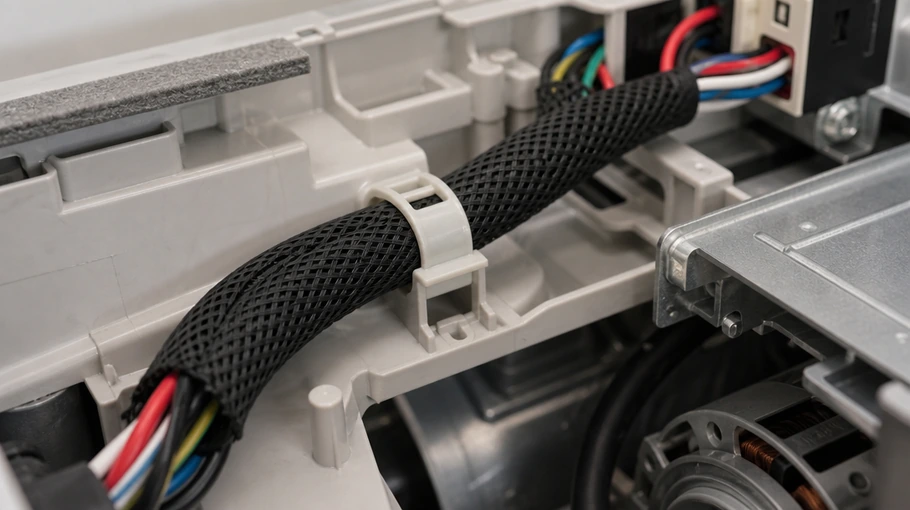
These harnesses flex constantly, which is why they fail from chafing, not heat. PET flame-retardant braided sleeving is thin, flexible and quiet. It bundles the looms and stops them from rubbing against each other or the bodywork.
Drive motors vibrate and run hot. Charging inlets see weather, dirt and repeated plugging. PTFE products and high-temp tapes protect these connections, where a failure means a tow truck, not a repair.
Every harness ends at a connector. Heat shrink tubing seals the transition from cable to terminal, keeping moisture out and strain off the crimp. Chengrun offers PTFE and standard grades in the sizes harness builders actually use.
Application |
Recommended Products |
Key Benefits |
Engine bay (150°C+ zones) |
Silicone fiberglass sleeving (SFT series), silicone rubber fiberglass sleeving |
High-temp rating, dielectric strength |
EV high-voltage cables |
Fireproof fiberglass sleeving, PTFE heat shrink |
Dielectric strength, flame resistance |
Chassis & underbody |
PA/PP corrugated conduit, braided mesh sleeving |
Abrasion resistance, cable organization |
Doors, seats & interior |
PET flame-retardant braided sleeving |
Flexible, quiet, anti-chafe |
Motor & charging connections |
PTFE heat shrink, high-temp tapes |
Extreme heat & chemical resistance |
Terminal sealing |
Heat shrink tubing (PTFE & standard) |
Moisture sealing, strain relief |
TS16949 matters here more than any single product spec. It is the system OEMs audit before a supplier gets a part number. Chengrun is the source factory, not a trader: raw material in, finished sleeving out, every batch traceable for PPAP-style documentation.
Automotive supply chain customers include BYD, Geely and Changan; the same product range serves battery and storage manufacturers Daqin New Energy and Jinzhao Era, and appliance brands Midea, Gree and TCL.
Send your harness drawings, operating temperature targets and compliance requirements to [WhatsApp]. An engineer, not a sales bot, will reply within 24 hours with a product recommendation and samples for validation.
Written by the Chengrun engineering team, Dongguan, China. [mailto:[email protected]]

 KO
KO