EN
Global wire harness production passed USD 95 billion in 2025 (Cableteque). Home appliances take a steady, demanding slice of that: ovens with 300°C interiors, washing machines that live in water, air conditioners that bake in direct sun for a decade.
An appliance is bought once and judged for years. The wiring inside it is invisible, but it decides whether the product lasts, and whether it is legal to sell.
Compliance decides what you can sell where. A cooker without UL-certified insulation does not enter the North American market, no matter how good the heating element is. ROHS and REACH decide Europe. For appliance OEMs and ODM factories, insulation is a compliance item first and a component second.
Chengrun has built insulation materials since 2001. The factory runs 1,000+ machines across two sites (30,000 m²), with 8 dedicated high-temperature lines and a TS16949 quality system. The sleeving, conduit, heat shrink, mesh and tapes protect harnesses for appliance brands including Midea, Gree and TCL. This page covers where insulation matters inside an appliance, and what to specify.
Short version: appliance failures and export rejections usually trace back to the same three words: heat, moisture, compliance.
Failure mode |
What happens unprotected |
Where it hits |
Oven and cooktop heat |
Insulation melts, wires short |
Ovens, hobs, toasters, self-cleaning cycles |
Moisture and steam |
Corrosion, tracking, leakage |
Washers, dishwashers, humid zones |
Vibration and flexing |
Chafing, broken conductors |
Motors, drums, door hinges |
Chemical exposure |
Tubing degrades and cracks |
Detergents, cleaning agents, cooking oils |
Compliance |
Market access blocked |
UL, ROHS, REACH requirements for export |
Cost pressure |
Over-spec burns margin |
Every meter, multiplied by millions of units |
Appliances are produced in the millions. A sleeving that is 5% over-spec costs real money at that volume, and a sleeving that is 5% under-spec costs a recall. The right specification is a balancing act, not a default.
The hottest wiring in the house. Oven interiors and self-cleaning cycles push well past 200°C, and ordinary PVC tubing fails there. Silicone fiberglass sleeving (SFT series) and silicone rubber fiberglass sleeving handle the heat, and hold their electrical properties at temperature.
Water, detergent and movement, every cycle. Heat shrink tubing seals the terminals and keeps moisture out; braided mesh sleeving protects the looms that flex with the drum. Chemical resistance matters more here than raw temperature rating.
Cold, not heat, is the enemy. Condensation forms on internal surfaces and drips onto wiring. PVC sleeving and heat shrink provide reliable insulation in damp, low-temperature conditions where flexibility matters during installation.
The outdoor unit works in full sun, rain and frost, for years at a time. Corrugated conduit and braided mesh sleeving protect the exposed cabling; high-temp tapes secure the connections near the compressor, where heat and vibration meet.
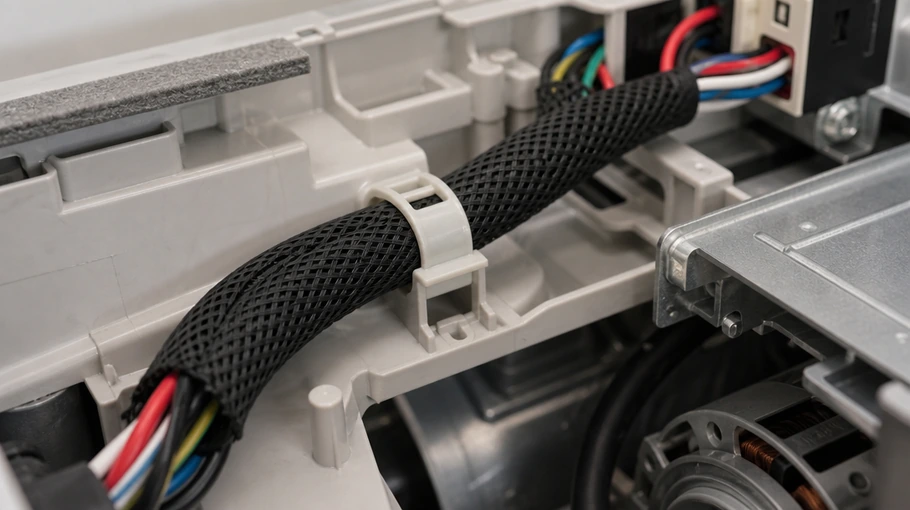
Blenders, vacuums, food processors: small motors run hot and vibrate constantly. Acetate cloth tape and fiberglass sleeving insulate the windings and lead wires, and hold up where thinner materials chafe through.
The part the user actually touches. UL-certified heat shrink tubing seals the cord entry into the appliance and the terminal connections, keeping strain off the crimp and compliance in the file. This is where safety certification earns its cost.
Application |
Recommended Products |
Key Benefits |
Ovens & cooktops |
Silicone fiberglass sleeving (SFT series) |
High-temp rating, UL compliance |
Washers & dishwashers |
Heat shrink tubing, braided mesh sleeving |
Moisture sealing, chemical resistance |
Refrigerators |
PVC sleeving, heat shrink |
Damp-condition insulation, flexibility |
Air conditioners |
Corrugated conduit, high-temp tapes |
Weather & abrasion protection |
Small appliance motors |
Acetate/cloth tapes, fiberglass sleeving |
Winding insulation, heat & vibration |
Power cords & terminals |
UL-certified heat shrink tubing |
Safety compliance, strain relief |
For appliance exporters, UL and ROHS documentation is part of the shipping paperwork. Chengrun provides certified materials with full traceability, so your compliance file is complete before the container leaves the port.
Appliance customers include Midea, Gree and TCL; the same product range serves automotive supply chains (BYD, Geely, Changan) and battery and storage manufacturers (Daqin New Energy, Jinzhao Era).
Send your appliance drawings, operating temperatures and export target markets to [WhatsApp]. An engineer, not a sales bot, will reply within 24 hours with a product recommendation and samples for validation.
Written by the Chengrun engineering team, Dongguan, China. [mailto:[email protected]]

 KO
KO